William Wolfgang Wunderbar is a Perfect User. One of many pseudo-anonymous accounts posting to the Facebook group of same name. WWW could be a collective, could be one person under several names. Anonymity is part of the form as is an attitude against attribution and authorship. The group thrived on people remixing each other's content and producing variations on a theme.
WWW was the first social media residency on Peripheral Forms' Facebook page through September 2016. WWW posted freely, I selected from the month and built the show. Each image had an OpenGraph share-back button: share one, and Facebook would scrape the metadata and pull the artwork back into the feed it had come from. The circulation was a part of the work, mirror the way the Perfect Users group worked. Clog the system, share everything, fail to show preference. The platform supplied the materials, the audience, and the distribution; the show recoded all three.
What looks now like an early study in slopulism was, at the time, just paying attention to how the platform was already breaking. Interface as medium, anonymity as form, hyperstition over critique. Easier to see from inside than it would have been five years later, after every gesture had been absorbed into content marketing.
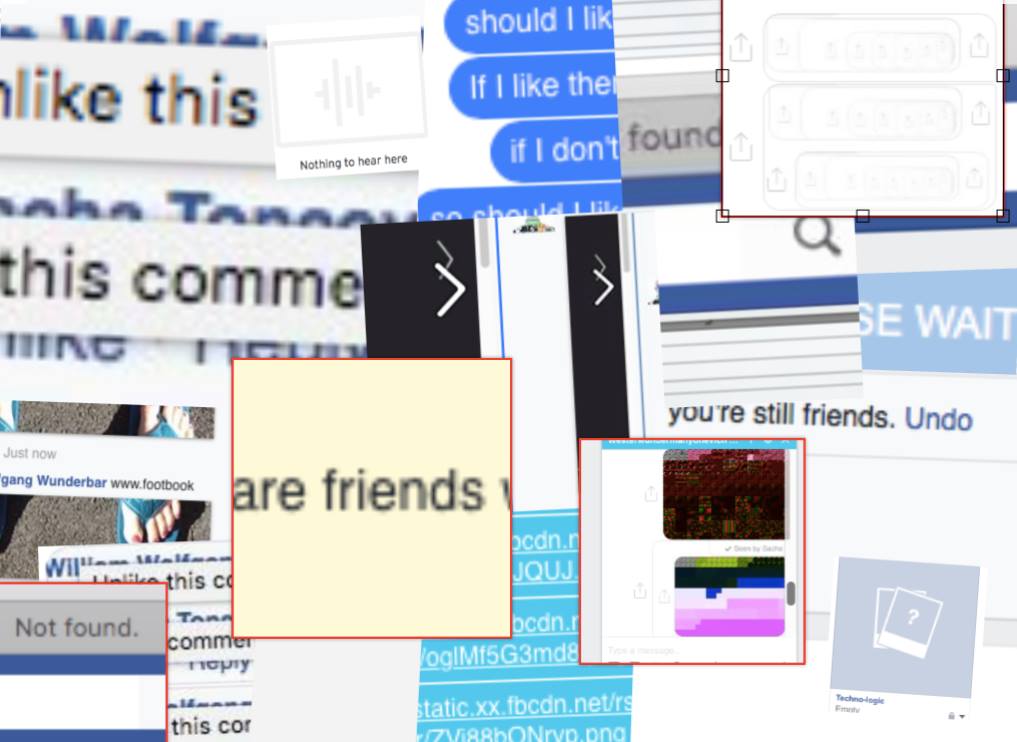
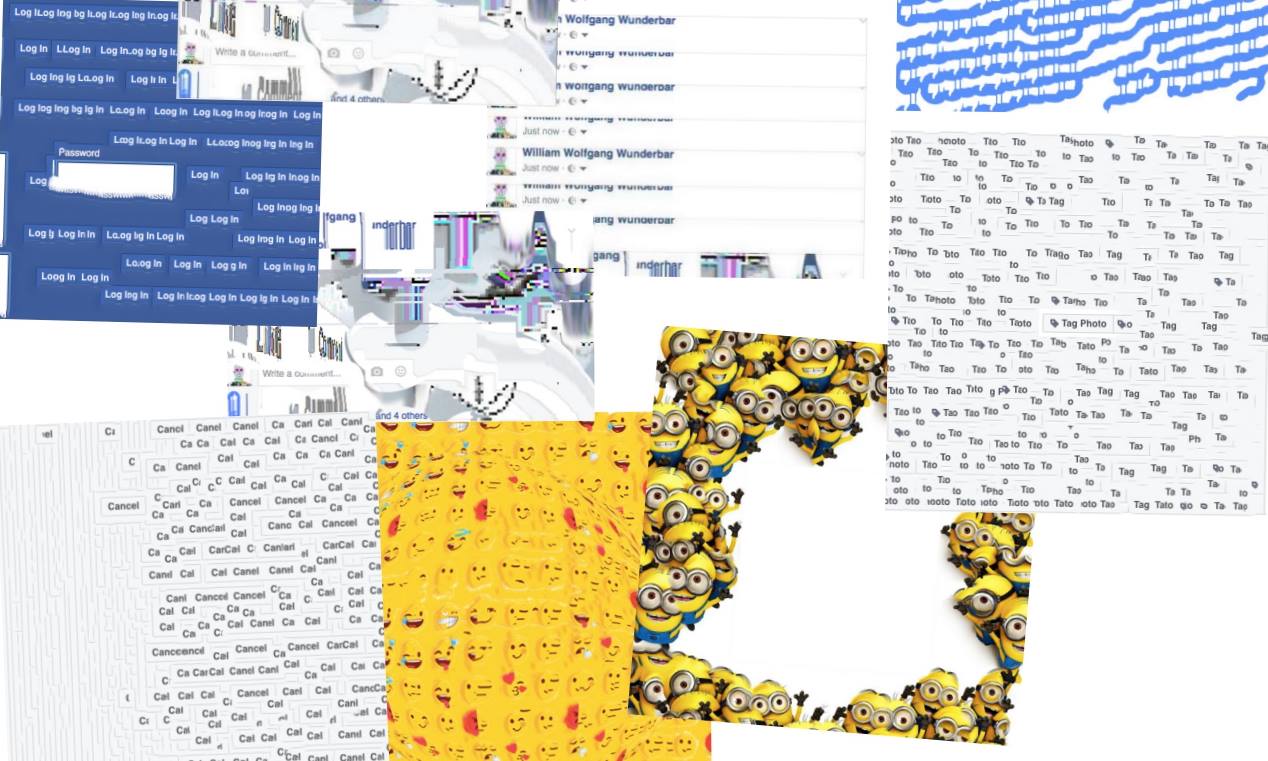
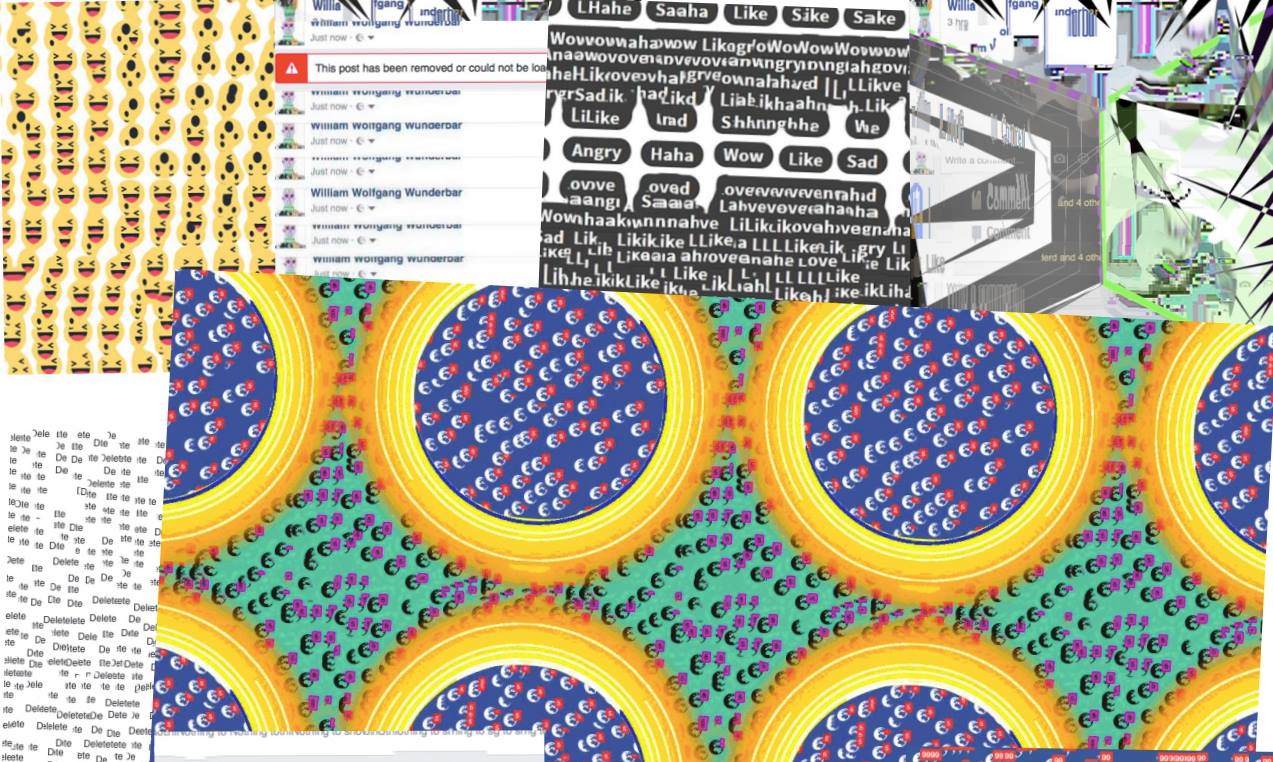
The shell of the content becomes the content. Photoshop's content-aware fill turned on the interface itself.
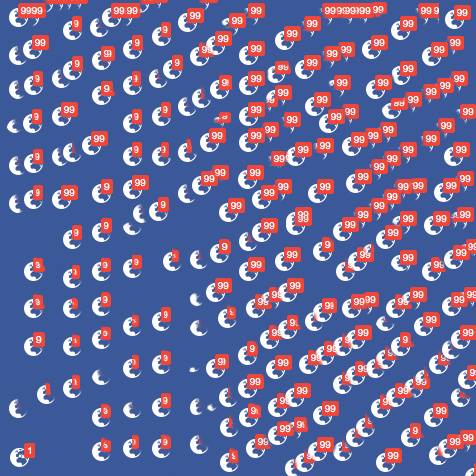
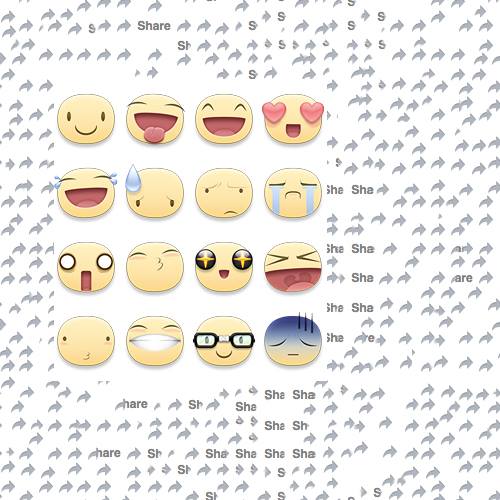
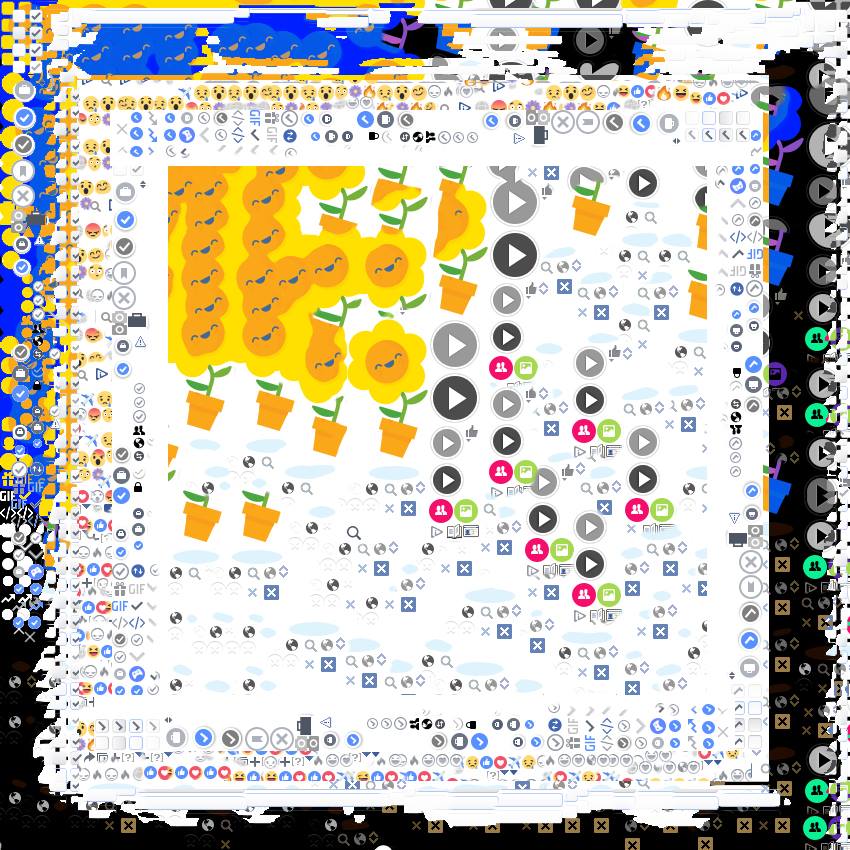
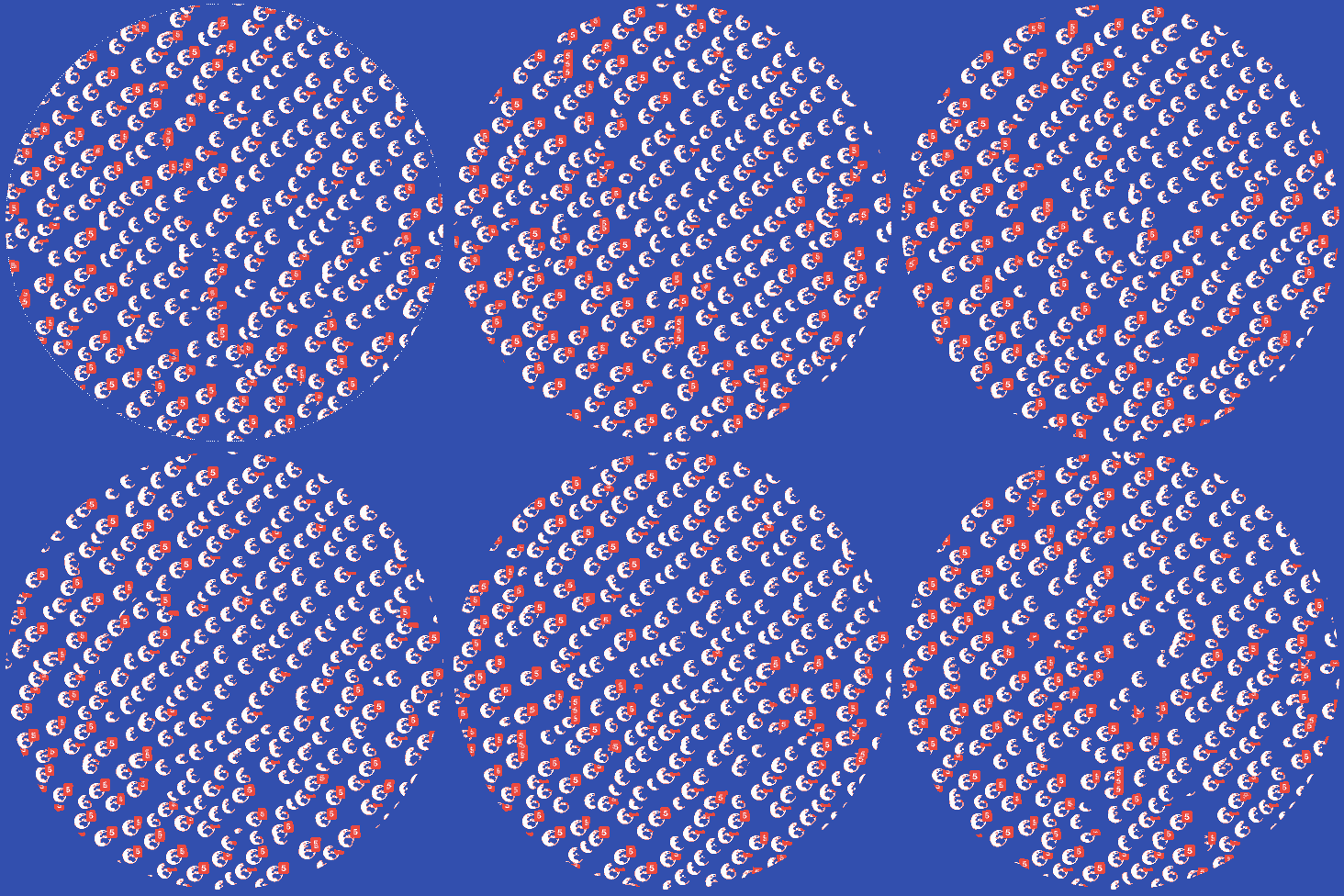
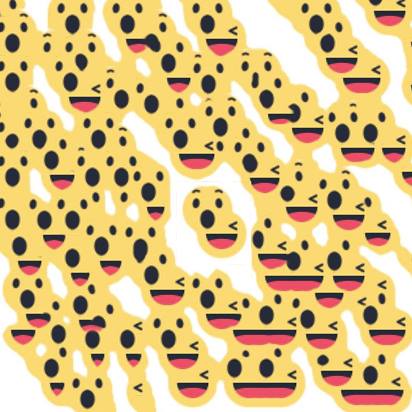
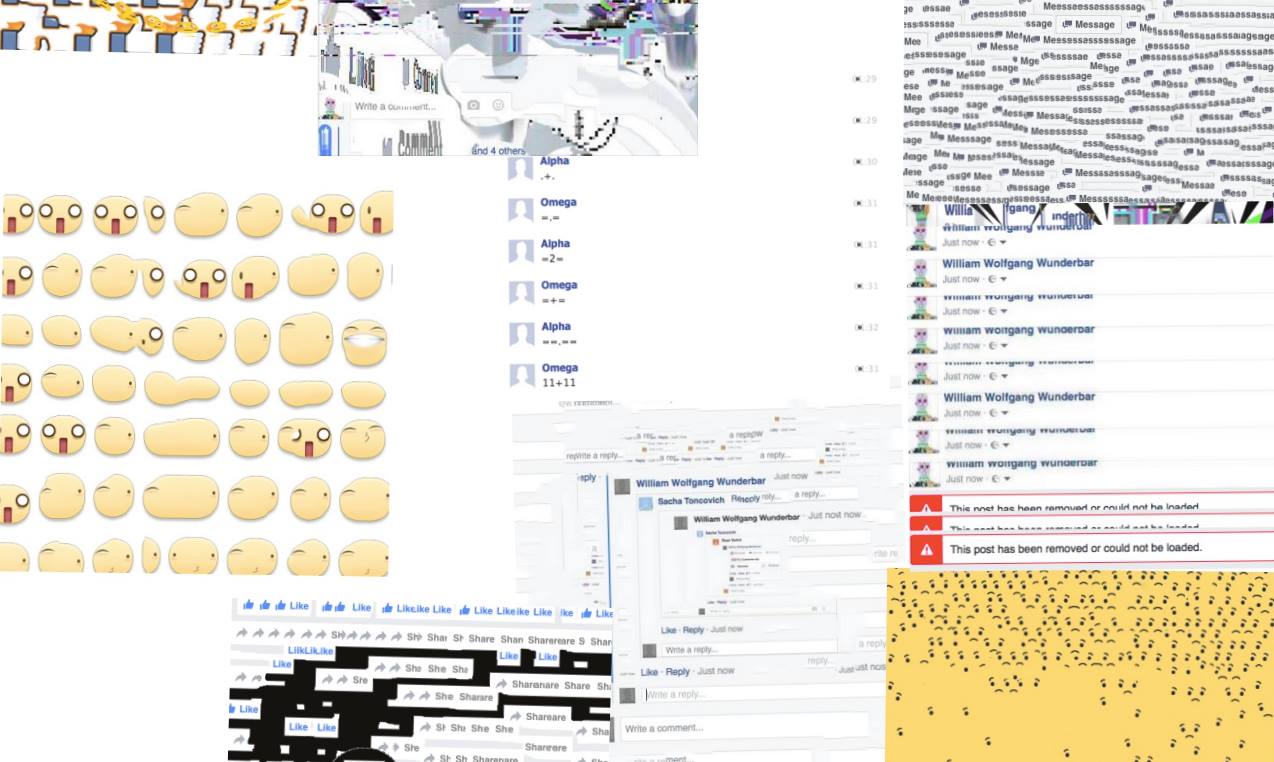
The six reactions Facebook gives you, broken and merged. Most feelings, Wunderbar wrote, can be traced to fear or love — but the surface is always grey.
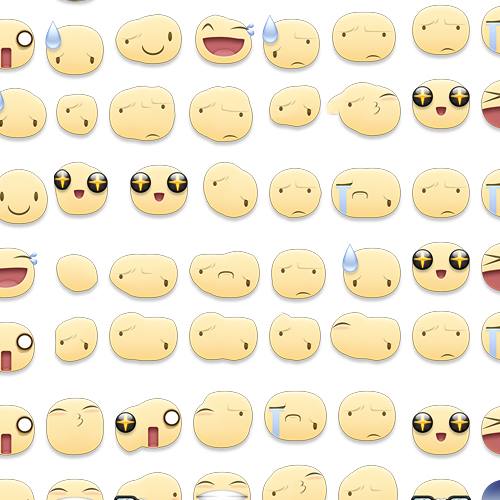
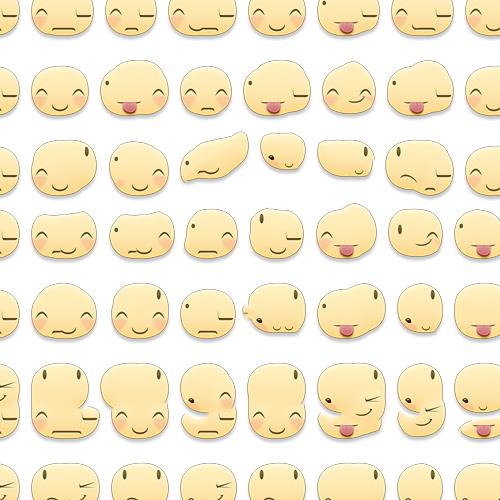
The two series collapsed. Compositions, collages, the masses behind the singular login.
artist statement
William Wolfgang Wunderbar
___S H A R E __ T H I S
___It basically a selection of two series of visual investigation I made on and with #Facebook. These images can give a new perspective and experience on something ordinary and present in our day to day experience. With the help of partial screenshots and photoshop's "content aware" function I remixed existing elements of net-culture.
___I N T E R F A C E B O O K
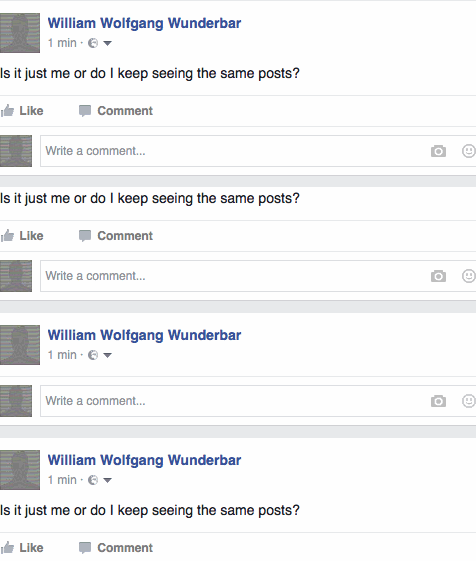
___The first series is "#interfacebook" where the #interface of Facebook (in a way the "shell" of the content we share) becomes content itself, I play/glitch, or in other words literally break the visual aspects of the interface to become more aware of it being part of the overall image that we face when using #fb. As with many things I have the feeling that it's so present that we almost don't see it anymore. This first series was then fed back into the interface; in "#normal" #posts on my #wall, where it can be perceived as a "real" #glitch or an extention/distortion of the interface.
___M I X E D F E E L I N G S
___The second series is "mixed feelings", (inspired by the work of Sacha Toncovich), because of the interface we are friendly "forced" to use a limited amount of #smilies/ #emoji/ #reactions to express ourselves. Also in this case I broke/glitched/mixed them in order to get new images of the same and because I know that most feelings can be traced down to the base of either fear or love, but on the surface levels #emotions and feelings can be rather mixed, so you can like something but be surprised, or #love something and #cry. It's a visual translation of the complexity of #human #feelings and with these images we can perhaps see the shades of grey.
___The works series are interconnected and as we experience Facebook from a singular point of view (#personal #login on a #screen), I found it interesting to visualise the masses that actually #use and #interact through this #platform, for example the masses of blended emoji-faces and the #globe of #likes.
___That was the basis, then the exhibition on www.sharethis.peripheralforms.com was an idea by Jah Justice. First he invited #WWW as an #online #Artist-In-Residence for the entire month of #september 2016, to freely #post and #share anything on Peripheral Forms' Facebook #page [...] And along the month he started selecting #images for the online show (including an "interfacebook" mountainous work from Kat Bernhardt!): www.sharethis.peripheralforms.com. From there the images can also be #shared back into Facebook so it keeps expanding.
curatorial statement
Jah Justice
It is not enough to reveal the repetitive patterns that transcend historical change. It is necessary to constantly repeat the revelations of these patterns — this repetition itself should be made repetitive, because every such repetition simultaneously produces clarification and confusion. Thus we need further clarification that again produces further confusion, and so forth. That is why the avant-garde cannot take place once and for all times, but must be permanently repeated.
If the goal of the historical avant-garde was to break down the barriers between art and everyday life and unleash the revolutionary potential of the creative human spirit, what would Beuys or Debord have to say about social media today? Certainly the barriers to the creation and circulation of aesthetic images have never been lower, and yet the barriers that define the aesthetic are still as tightly maintained as ever, firmly defending market value by holding up the celebrity status of "important" artists, living and dead.
While we believe that the making and distribution of digital images inherently trends against financialization, we find ourselves just wrapped up again in a new market of attention, measured in likes and shares, with the vague hope that being king of the likes might put some coin in the coffers (though how that promise might actually be fulfilled remains extremely elusive).
While the gatekeepers of the art market are, at this point, well understood, what about the gatekeepers to that great feed-mill on the hill? Why do some posts gain enormous traction while others that are nearly identical remain unnoticed and unacknowledged? The reality is that those gatekeepers are, on some level, us — the mob, the crowd, the users — simply reinforcing the hierarchical structures of the world around us in the way that we like, comment, and share, keeping up appearances of a respectable curatorial practice in our feeds, another manifestation of our desire to define our politics, ethics and personalities through our consumption of images and ideas.
A vainglorious effort, since none of our attention-overloaded friends are likely to be able to parse which posts we liked and which memes we shared. We probably will not even remember what we ourselves have posted or seen within a matter of days, perhaps even hours. In fact, the main benefactors of our careful curation are marketers who are modeling who we want to be seen as in order to better sell us a roadmap to achieving our future selves.
We invite you to share these images extensively, to reinsert them into the platform they are abstracted from as a kind of institutional critique. We invite you to share as many images as possible, from this show or from any source really. As long as we remain chained to these interfaces designed to commodify our expressions of self, the best answer that we have is to clog the system with useless information, to like everything, to share everything, to fail to show our preference.